
A Wave Of Acceptance Interest
1. C2B Acceptance Stablecoins Activity Timeline in 2025
(selected; non-exhaustive)
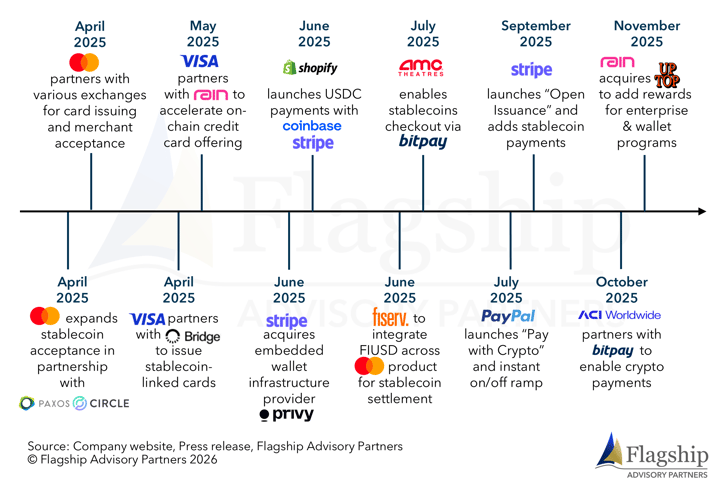
Stripe’s $1B acquisition of Bridge in the summer of 2024 brought credibility to the stablecoins space after years of ‘crypto-winter’. Although the investment thesis was likely built on powering Stripe’s $2T of global settlement flows, Stripe’s positioning as the leading ecommerce PSP led to a common hypothesis that this heralded adoption of stablecoins as the consumer payment method of the future. Since then, a slew of acceptance-related stablecoin announcements have hit the market; effectively every major PSP has announced partnerships with stablecoin acceptance specialists and major media outlets reported rumors that America’s largest merchants were exploring stablecoins or building towards pilot tests
The Cost Hypothesis
The core hypothesis is that stablecoin acceptance is a lower-cost alternative to cards, similar to the thesis for Pay By Bank. With business confidence in the U.S. and across OECD countries at lower levels than we’ve seen in the last 20 years (except for troughs during the worst of 2008 and 2020), retailer margins under pressure and continuing legal battles over interchange and surcharging, the cost of payment acceptance has never been under more scrutiny.
Core stablecoin payment processing can cost very little compared to traditional rails – a fraction of a penny versus a few cents for a bank transfer, $0.20 for a debit card payment or a few dollars for a check or wire. Many people see this cost advantage as a potential threat to card networks and other existing payment rail.
2. Merchant Acceptance Cost: Tradutional Payment Methods vs. Stablecoins
(based on a $100 transaction in the US)
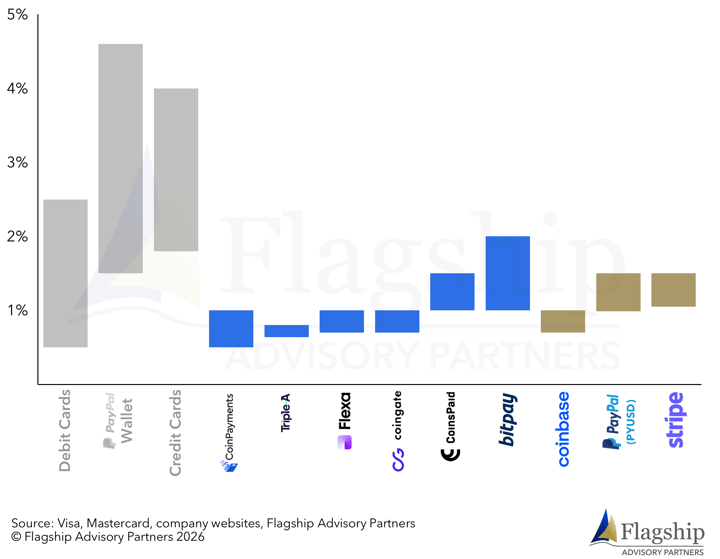
Flagship analysis does show that stablecoin PSPs do appear to offer lower acceptance costs (0.8%-1.4%) compared to market norms in the US (0.5%-2.5% for debit cards and 1.8%-4% for credit cards). When PSPs are able to acquire stablecoins from consumers on-chain, merchants can benefit from the improved economics.
That being said, cost is not the only attractive characteristic that stablecoins have for retail payments. Depending on the use case, they can provide:
- Security (as a bearer instrument, payments are irreversible once confirmed), speed (settlement can happen 24/7 in minutes)
- Access (both for customers, who can more easily access currencies relevant to a merchant, and for merchants, who want to transact in global markets without foreign currency acceptance), and
- Programmability (smart contracts can automate conditional payments like escrow)
The value proposition is therefore credible, if theoretical for most use cases, justifying the wave of product launches in the past 18 months.
Acceptance Models
3. Stablecoins Payment Acceptance Models
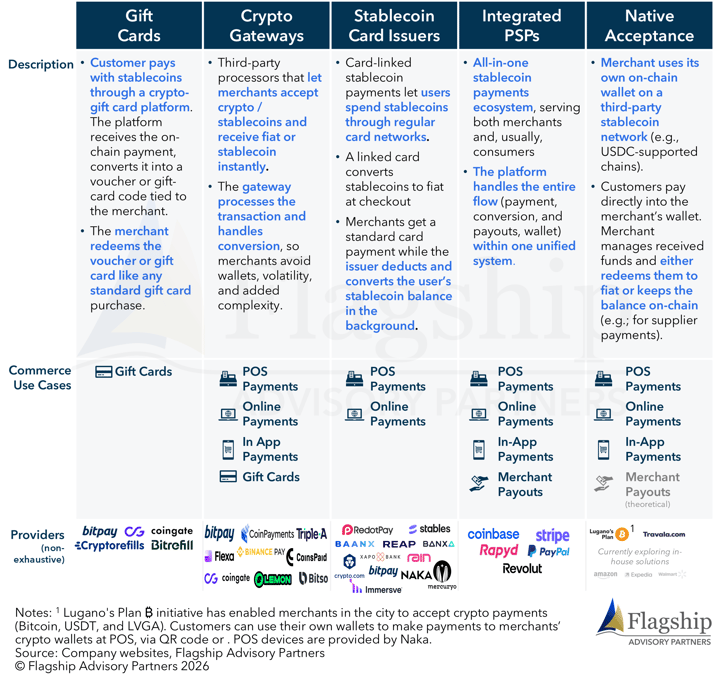
There are several ways stablecoins can play a role in retail payments acceptance:
- As a direct means of payment, sent directly on-chain from the consumer to the merchant
- Sent from the consumer to the merchant’s PSP, who converts the stablecoin into fiat currency before settling to the merchant
- As an enabler of agent-to-agent payment flows, though true agentic payments are very early stage and will likely take years to develop
- Indirectly, to purchase prepaid debit (gift) cards, which consumers then use to pay in fiat over traditional card rails and settlement flows
- Through the use of stablecoin-funded cards (“stablecards”), which either convert stablecoin to fiat just before settling with card rails or actually settle stablecoin with the network (Visa now supports in stablecoin settlement using USDC, PYUSD, USDG, and EURC. Mastercard’s acquisition of BVNK will enable it to do the same.)
The specifics of how payment and settlement are enabled play a big role in cost and functionality. Paying directly ‘on-chain' from one wallet to another can be extremely cheap but it also requires both parties to have wallets, a way to easily communicate the merchant’s wallet address and patience for a highly unstructured payment experience. That could work in developing markets with volatile currencies where stablecoins reach a critical mass of adoption (enough for merchants to put QR codes on their websites or checkout counter). Our experience and recent research indicate that is very unlikely to be how things evolve in regions like the US, Canada, UK, and the EU.
Stablecoin Acceptance Today
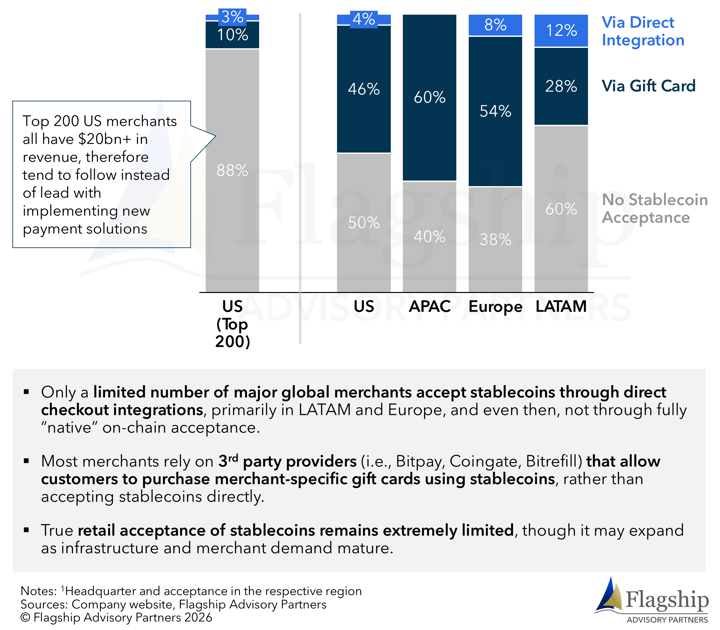
Flagship recently canvassed the websites of the top-50 regional merchants across Europe, Asia-Pacific, and Latin America. This research confirmed that direct acceptance of stablecoin (either on-chain or through a specialist PSP like BitPay) remains very low: just 4% of the top-50 U.S. merchants, 8% of large European merchants, and 12% of large Latin American merchants accept stablecoins as an ecommerce payment method. Conversely, a surprisingly high share of large merchants (about half) across these regions have agreed to participate in the ‘gift card malls’ of providers like BitPay, Coingate and Bitrefill, which allow customers to use stablecoin and cryptocurrency to buy merchant-branded gift cards.
4. Stablecoins Region Acceptance1
(top 50 merchants by revenue)
5. Bitpay's1 Global Merchant Directory by Vertical and Acceptance Mode
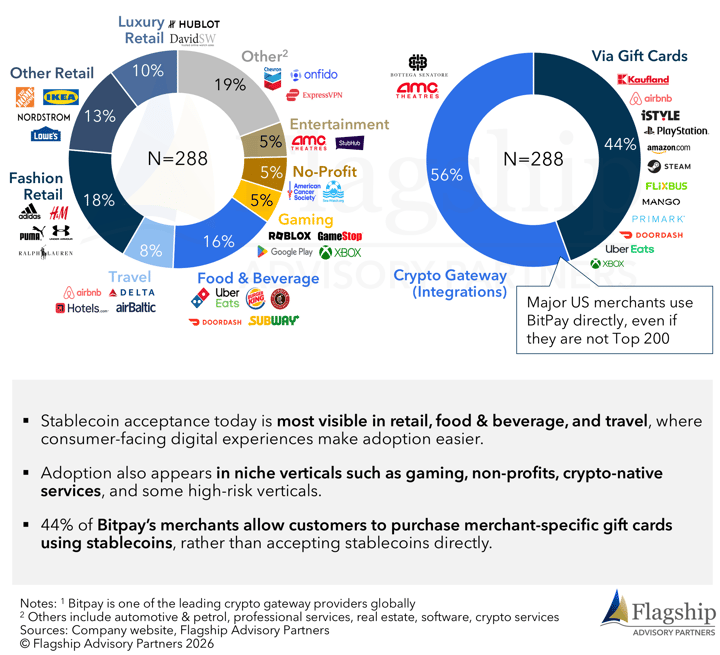
We see some interesting patterns in the specifics of which merchants have enabled native/direct acceptance or agreed to participate in the ‘crypto gift card malls’:
- Greater participation in higher-risk and privacy-related verticals such as VPN purchasing and gaming show the flywheel effect of adoption where consumers already hold stablecoins
- Multiple brands in fashion retail, luxury (e.g. jewellery, automotive), real estate and any vertical with a high average consumer ticket value have integrated with 'gift card malls'
- Multiple brands in verticals with lots of business customers - such as home goods, hardware and travel - may indicate greater fit in areas where costly commercial cards are more common or businesses holding stablecoins may be looking to spend them for business operations
- Outside of the US, merchants operating in harder-to-serve regions, or high-expense regions (e.g. due to fraud, FX exposure) have been the most likely to participate
Mass Market Challenges
If stablecoins clearly cost less than cards, why aren't they more broadly accepted?
Well, most importantly, very few consumers in developed markets hold stablecoins and almost no one uses them for payments: we estimate about 5% of U.S. adults own stablecoins and the Fed’s SHED survey found only 2% were using stablecoins (or any type of cryptocurrency) to pay in 2024. Globally, the picture is different: ARK Invest estimates that stablecoins have reached approximately 200 million users worldwide (based on Chainalysis address data), including about 20% of all non-U.S. resident dollar holders.
Stablecoins also don't provide a value opportunity for consumers: no rational consumer would convert fiat to stablecoins (at a cost) solely to spend them (and forego card rewards). The addressable market is generally limited to those already receiving stablecoins through payroll, remittances, or other inflows. The industry needs to make it easy for those people to spend stablecoin (which is most likely to happen through stablecards, in our opinion).
Perhaps the more important barriers for merchants exist beyond the checkout form: tax and accounting policy have not historically treated digital currencies (including stablecoins) as currency. Their classification as intangible assets under IFRS and GAAP and as property by the IRS means significant incremental tax and compliance work for corporate treasury teams. However, this is changing: IFRS now treats MiCAR-compliant stablecoins as cash equivalents and FASB added stablecoin cash-equivalent classification to its technical agenda in October 2025 following the passage of the GENIUS Act. If GAAP starts to treat stablecoins as cash equivalents, we expect the IRS will also update its tax policy, removing another hurdle to the adoption of stablecoins for payments.
Conclusion & Key Takeaways
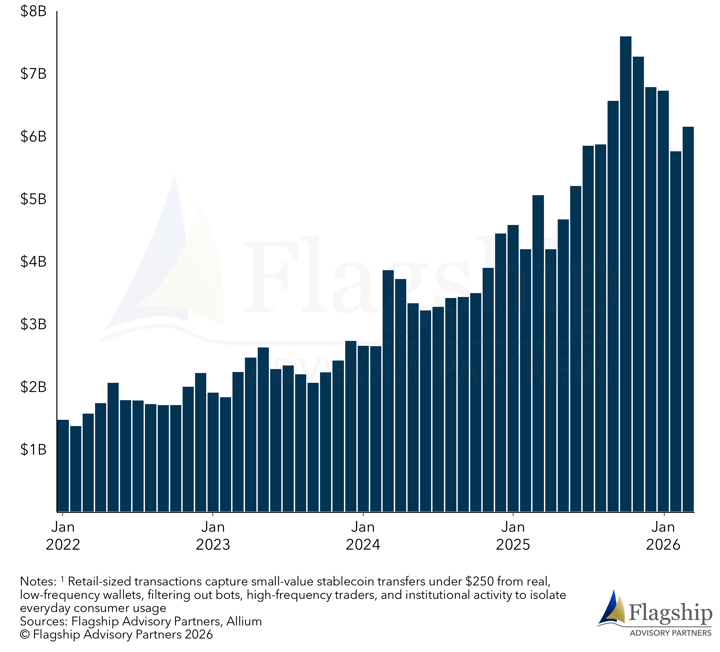
According to Allium data, retail-sized stablecoin payments are growing rapidly (about 83% year over year, based on Q4 2025) but they remain very niche – about $70 billion globally in 2025. For context, the major card networks now process more than $50 trillion globally each year.
6. Retail-Sized1 Monthly Stablecoin Transaction Volume
(in $ billion)
 As with other alternative payment methods before them, low cost alone is not sufficient to drive adoption. We expect increased uptake where stablecoins offer a specific value proposition beyond price: in regions with elevated fraud or FX costs, in verticals with complex payments that can benefit from the conditional/escrow payment capability of smart contracts, and among merchant categories where crypto-native consumers are already concentrated. Merchants should evaluate their particular opportunity rather than treat stablecoin acceptance as a universal imperative.
We believe consumer readiness of stablecoins will follow businesses, not the other way around. As stablecoins enter the consumer ecosystem through payroll, gig economy earnings, and cross-border payouts, the flywheel effect will expand the pool of holders who can spend without on-ramping.
This outcome could be disintermediating to banks and to some extent card networks and PSPs: once a consumer holds stablecoins and starts to use them on-chain, without off-ramping, banks and their enablers are not part of the funds flow at all. As the consumer payments space increasingly – if slowly – evolves into stablecoins and a broader range of payment methods beyond cards, incumbent banks, networks and PSPs need to consider the role they will play in a multi-rail future, rather than avoiding cannibalizing interchange. This could be solving existing problems as the space matures, staking a claim in the future of the stablecoins value chain, such as enabling on/off ramping, or (most importantly) secure / easy consumer custody – or it could be fixing forward for the future, such as multi-rail orchestration.
With Mastercard’s $1.8B acquisition of BVNK last month and Visa joining the Canton Network as a Super Validator, the wind is certainly pointing in the direction of adoption of new rails by the incumbent ecosystem. While consumer adoption as a payment method may be a slower burn, there’s good reason to believe stablecoins are likely to displace other payments flows, particularly as settlement rails. Merchants and gateways may have the freedom to “wait and see” how the use of stablecoins in payments plays out but banks and money-movement PSPs that should be working now to evaluate the long-term impact to their role in the payments ecosystem.
As our series of articles progresses, we’ll click deeper into those near-term opportunities and threats – from issuance of proprietary stablecoins, re-engaging in the wallet wars and providing the access to settlement by stablecoin.
Please do not hesitate to contact William Hay at Will@FlagshipAP.com, or Alessandro Mighetto at Alessandro@FlagshipAP.com with comments or questions.