
Introduction
On January 22, 2026, Capital One (a top-10 U.S. bank) announced that it will acquire Brex, a corporate spend management and treasury platform, in a $5.15 billion 50/50 cash-and-stock transaction, expected to close by mid-2026. The deal is one of the largest ever fintech acquisitions by a bank and latest in an active B2B fintech deal environment.
Many headlines focused on the purchase price and valuation of Brex (down from its $12B peak in 2022), but we see the transaction, most importantly, as further development in the convergence between “Office of the CFO” software and financial services. This article unpacks the deal rationale, execution risks, and broader impact on the B2B fintech ecosystem.
Why Capital One Bought Brex
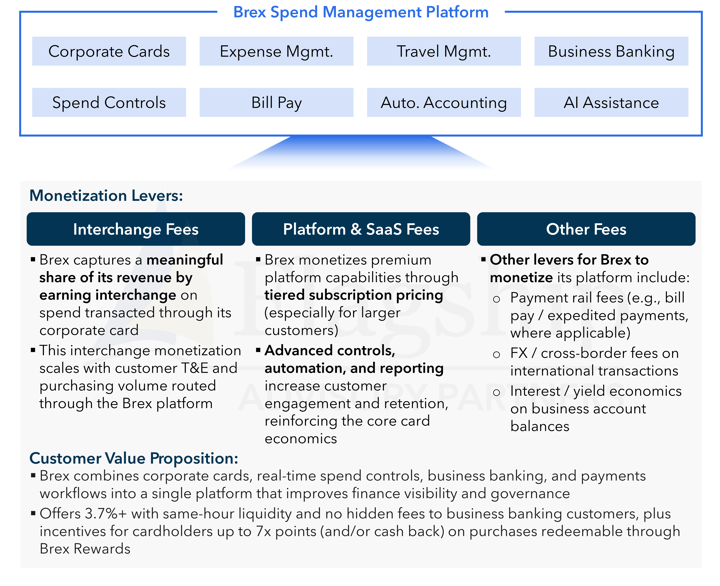
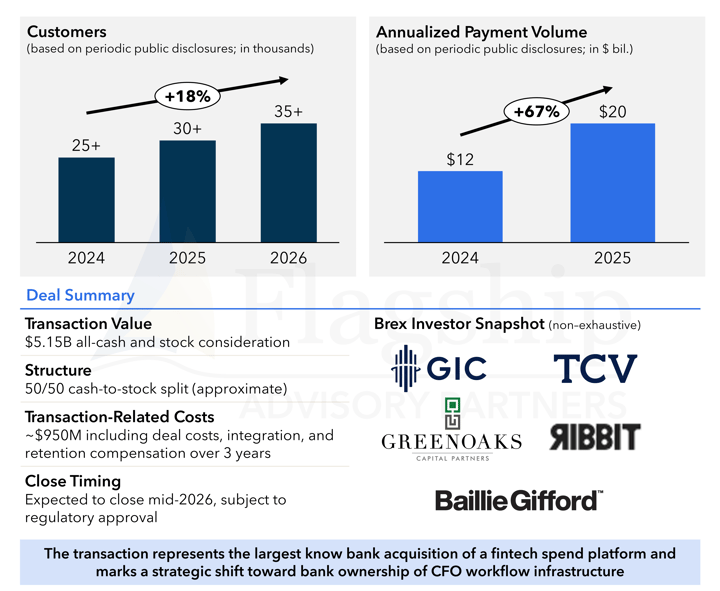
Capital One’s acquisition of Brex reflects the bank’s ambitions to move beyond commoditized banking services (cards and deposits) towards being a platform at the center of a CFO’s operating stack. Brex’s proposition combines corporate cards, cash management, and spend controls into a single package that targets tech-forward SMBs and growth businesses. For Capital One, this provides a strong product for cross-sell to existing business banking customers and a new lead product for attracting tech-forward customers. In Figures 1 and 2, we highlight what Capital One is getting, including Brex’s product & platform capabilities, publicly disclosed financial performance, and specifics about the deal.
Figure 1: Brex Overview
(product & platform, non-exhaustive)
 Sources: Flagship Advisory Partners Market Research & Observations
Figure 2: Brex Overview
(based on public disclosures as of Feb. 2026)
 Source: Flagship Advisory Partners Market Research & Observations
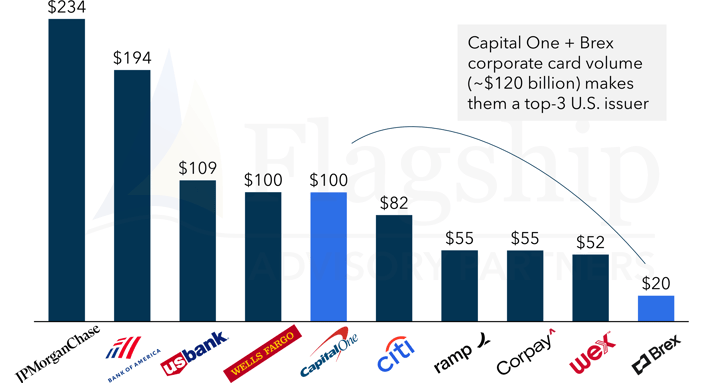
Brex brings a base of roughly 35,000 customers and modern, data-centric financial workflow solution that aligns with Capital One’s commercial banking ambitions. Capital One CEO Richard Fairbank stated, “Since our founding, we set out to build a payments company at the frontier of the technology revolution… Acquiring Brex accelerates this journey, especially in the business payments marketplace.” Brex’s API-driven, modular technology stack provides Capital One with software-native capabilities that would be difficult to develop organically within a traditional bank's operating environment. Combined with Capital One’s balance sheet strength, deposit funding, and underwriting scale, the acquisition (on paper) enables the company to support customers with credit and treasury solutions at a scale greater than any other B2B fintech. As we illustrate in Figure 3, Brex and its $20 billion in virtual and physical corporate T&E and purchasing cards would bring Capital One's commercial card spend well above $100 billion, making it a top-3 corporate card issuer in the U.S.
Figure 3: Top U.S. Corporate Card Programs by Purchase Volume
(directional purchase volume, in $ bil.)
Transaction Economics & Potential Capital One + Brex Upsides
Brex’s revenue model is driven by card issuing economics where Capital One can introduce further synergies and optimization, for example:
-
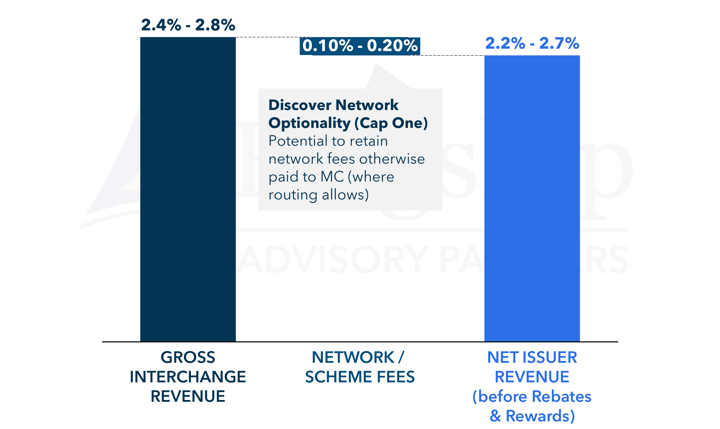
Interchange and interest income: U.S. issuers earn meaningful interchange revenue and interest on credit card balances. Routing transaction volume through an issuer that also owns the network (e.g., American Express) or has favorable network arrangements (e.g., JPMorgan Chase) can materially impact the net economics captured. Standard four-party card models distribute value across networks, issuers, acquirers, and merchants; controlling more of these layers structurally improves economics. Capital One will surely find ways to accelerate interest (float) and lending revenue from Brex customers.
- Discover network optionality: Capital One owns the Discover network, which allows Capital One to internally retain network fees that would otherwise flow to third parties. Routing Brex card volume onto the Discover network could boost card economics and enhance net take rates, contingent on merchant acceptance and routing strategy. Even if Brex’s issuing volumes remain on Mastercard, Capital One will surely extract leverage synergies on the network economics.
Figure 4: Illustrative Card Transaction Waterfall
(highlighting issuer economics & discover network fee retention)
Source: Flagship Advisory Partners Market Research & Observations
Bank-Owned Fintech Execution & Competitive Risks
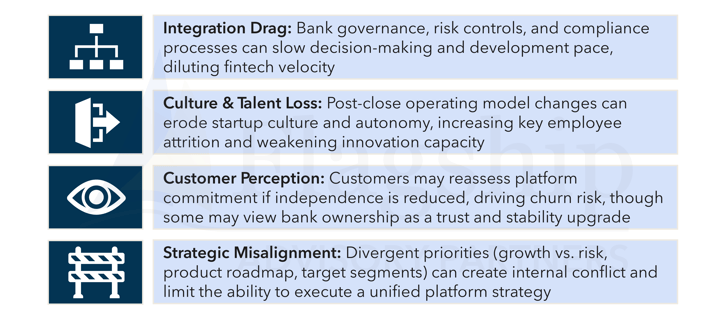
Banks have a spotty record for value-creation buying technology companies, although Capital One is considered more tech-forward than most of its large bank peers. Capital One’s large bet feels like an inflection point, but it also brings well-documented execution risks, as we describe in Figure 5.
As an illustrative example of strategic misalignment, Brex’s planned international expansion announced in 2025 (via its Dutch Payment Institution license to support pan-EU operations) is now in question, as Brex’s EU footprint is likely less central to Capital One’s immediate commercial priorities absent any explicit post-close strategy announcements.
Figure 5: Why Bank–Fintech Acquisitions Are Challenging
(reoccurring risk/observations across prior deals)
 Source: Flagship Advisory Partners Market Research & Observations
Integration execution and avoiding self-inflicted wounds will be critical for Capital One this year into next. But in the meantime, we expect to see Brex’s competitors lean into marketing the deal as weakening the innovation of the company. Two risks stand out:
- Brand and product loyalty: The announcement itself may prompt finance teams to reassess platform commitments if they worry about the bank slowing down the development roadmap.
- Competitive attacks: Independent fintechs (including Ramp) will emphasize agility and product autonomy as differentiators against bank-owned incumbents.
Ramp (Brex’s closest competitor in spend and treasury workflows) released its own public reaction HERE, which explicitly frames the acquisition as introducing uncertainty about product direction, pricing, underwriting, and integration, language that serves competitive positioning but also highlights where market share battles can occur.
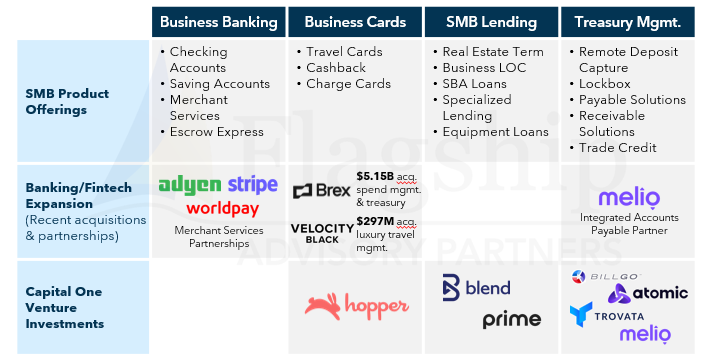
While Brex represents Capital One’s largest fintech bet, the deal is consistent with Capital One’s ambitions to expand its positioning in business banking. Prior to Brex, Capital One acquired premium lifestyle and concierge platform Velocity Black in 2023 to accelerate its presence in high-end digital experiences. Going back further, Capital One acquired trade credit provider BlueTarp in 2019, which today operates as Capital One Trade Credit and, at the time, extended the bank’s footprint into SMB and B2B purchasing workflows. Figure 6 illustrates some of Capital One’s recent SMB banking-related partnerships, acquisitions, and venture investments.
Figure 6: Capital One SMB Banking Product Domain
(partner, acquisition, and venture logos non-exhaustive)
 Source: Flagship Advisory Partners Market Research & Observations
Conclusion
Capital One’s acquisition of Brex is a continuation of the convergence between Office of the CFO software and financial services.. Most of the deals in B2B fintechs over the last two years were non-bank fintechs buying smaller, capability-led technology companies to complement strategic partnerships and organic platform development investments. Banks have generally learned to been cautious buyers of fintechs at fintech valuations. However, the swoon in B2B fintech valuations made Brex a target for ambitious Capital One, who will now lean heavily on Brex as a growth engine for business banking.
Please do not hesitate to contact Rom Mascetti at Rom@FlagshipAP.com with comments and questions.