Designed by Freepik
Innovations
Innovations
Image Credit: Designed by Freepik
Ryan McDonald, Abigail Karl • 18 March, 2026
Underwriting Discipline Continues to Hold Credit Losses at Bay
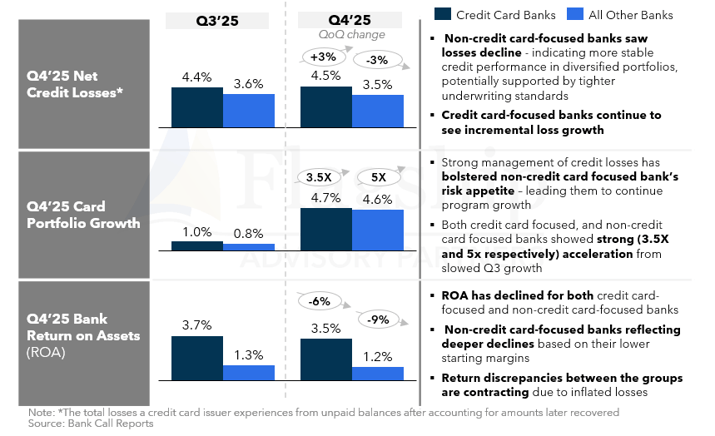
The fourth quarter of 2025 showed stabilization in the recent upward credit loss trend in bank credit performance, while portfolio growth remained intact despite mounting signs of consumer fragility. As non-credit card-focused banks demonstrated improving chargeoff stability and sustained risk appetite, credit card-focused banks continued to experience incremental loss pressure. Bank programs show slowing but still positive loan growth and tightening return profiles, but are proving more resilient than anticipated, even as profitability headwinds and investor concerns around credit quality persist.
1. Non-Credit Card Banks Vs Credit Card Banks Key Metric Comparison
(Q3’25 vs. Q4’25 consumer receivables)
Q2'25 Net Credit Losses
- Card losses are down across all banks from Q1'25 with CC focused banks slower to course-correct.
- This sharp downturn in credit losses could indicate that consumers financial status could be more resilient than market expectations.
Q2'25 Card Portfolio Growth
- Card receivable growth rapidly transitioned from mid-single-digit contractions in Q1’25 to modest growth in Q2’25.
- Bringing total card receivables close to Q4’24’s historic high of $1,458B.
Q2'25 Bank ROA
- Returns for card focused banks continue decline towards banks with diversified balance sheets due to the markedly higher credit losses degrading CC Bank economics.
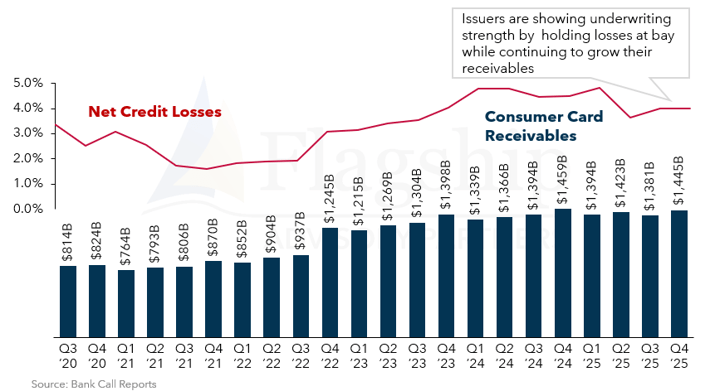
2. Market Size and Credit Loss Performance
(Q1'20 vs. Q2'25 consumer receivables)
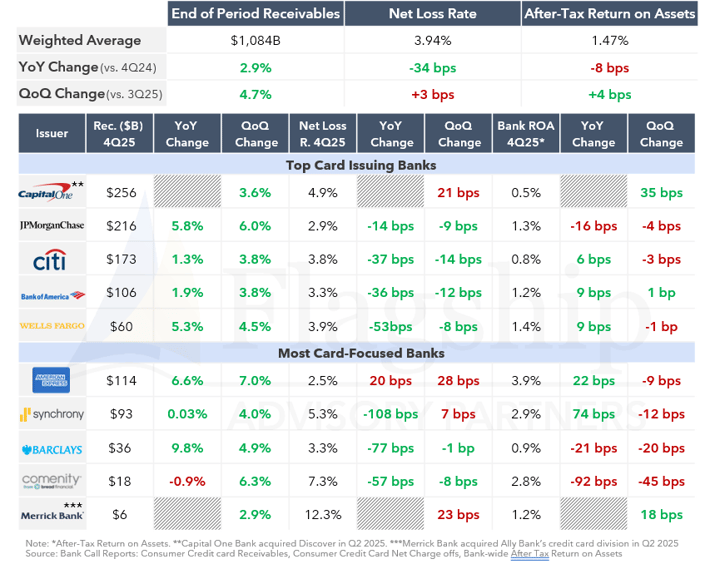
3. Key Player Performance
(consumer credit card receivables)
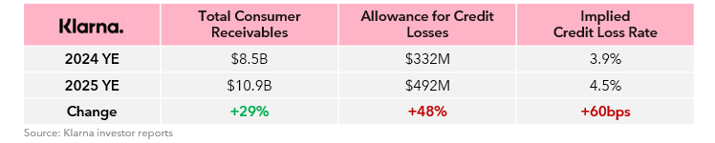
4. Klarna’s BNPL Performance
General Commentary & Highlights
- As signs of consumer fragility continue to grow, banks have effectively managed credit losses while still maintaining portfolio growth.
- Both banks and fintech lenders have experienced sharp investor pullbacks in reaction to small but measurable changes in KPIs. For instance, in the days following recent quarterly results, Klarna’s share price declined 32%, Affirm declined 16%, and Capital One declined 8%, in all cases due in part to concerns of declining credit quality even alongside impressive revenue growth.
- Affirm’s fiscal year concludes in June, but mid-year reporting indicates their loans held for investment are remaining near their historic loss rates of ~5.5%-5.75%.
Please do not hesitate to contact Ryan McDonald at Ryan.McDonald@FlagshipAP.com with comments and questions.
Image Credit: Designed by Freepik
Underwriting Discipline Continues to Hold Credit Losses at Bay
The fourth quarter of 2025 showed stabilization in the recent upward credit loss trend in bank credit performance, while portfolio growth remained intact despite mounting signs of consumer fragility. As non-credit card-focused banks demonstrated improving chargeoff stability and sustained risk appetite, credit card-focused banks continued to experience incremental loss pressure. Bank programs show slowing but still positive loan growth and tightening return profiles, but are proving more resilient than anticipated, even as profitability headwinds and investor concerns around credit quality persist.
1. Non-Credit Card Banks Vs Credit Card Banks Key Metric Comparison
(Q3’25 vs. Q4’25 consumer receivables)
Q2'25 Net Credit Losses
- Card losses are down across all banks from Q1'25 with CC focused banks slower to course-correct.
- This sharp downturn in credit losses could indicate that consumers financial status could be more resilient than market expectations.
Q2'25 Card Portfolio Growth
- Card receivable growth rapidly transitioned from mid-single-digit contractions in Q1’25 to modest growth in Q2’25.
- Bringing total card receivables close to Q4’24’s historic high of $1,458B.
Q2'25 Bank ROA
- Returns for card focused banks continue decline towards banks with diversified balance sheets due to the markedly higher credit losses degrading CC Bank economics.
2. Market Size and Credit Loss Performance
(Q1'20 vs. Q2'25 consumer receivables)
3. Key Player Performance
(consumer credit card receivables)
4. Klarna’s BNPL Performance
General Commentary & Highlights
- As signs of consumer fragility continue to grow, banks have effectively managed credit losses while still maintaining portfolio growth.
- Both banks and fintech lenders have experienced sharp investor pullbacks in reaction to small but measurable changes in KPIs. For instance, in the days following recent quarterly results, Klarna’s share price declined 32%, Affirm declined 16%, and Capital One declined 8%, in all cases due in part to concerns of declining credit quality even alongside impressive revenue growth.
- Affirm’s fiscal year concludes in June, but mid-year reporting indicates their loans held for investment are remaining near their historic loss rates of ~5.5%-5.75%.
Please do not hesitate to contact Ryan McDonald at Ryan.McDonald@FlagshipAP.com with comments and questions.