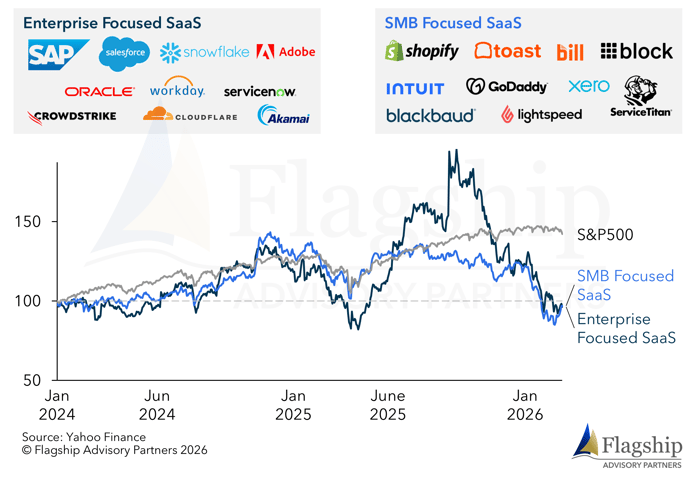
The software industry is panicking as bears latch onto the theme of AI disrupting the software industry, assuming that AI will be able to develop custom code that is superior or lower cost. Investors are clearly spooked, the flight from software equities has been bloody as we illustrate in Figure 1 below. We agree that AI will be good at writing code and customizing workflows, no question. However, it feels like the baby is being thrown out with the bathwater in the equity markets, as we see AI boosting the prospects of many market-leading Software-as-a-Service (SaaS) companies, though it is also threatening others. In this article, we apply an executive-level lens to defining the disruption concerns, assessing practical realities to this disruption risk, and prognosticating on market impacts.
Market Fears
Let’s first examine the market’s reaction to the threat to software from AI. Figure 1 illustrates a sample of share price movements across the software industry (we bucket B2B software companies as either enterprise or SMB focused for later discussion). These software indices are now trading down –43% (enterprise) and –59% (SMB) from valuation peaks. The SMB cohort is more negatively impacted than enterprise, a result which we will question shortly.
Figure 1: SaaS Stock Price Performance
(select player only; stock price % change as compared to January 2, 2024; base 100)
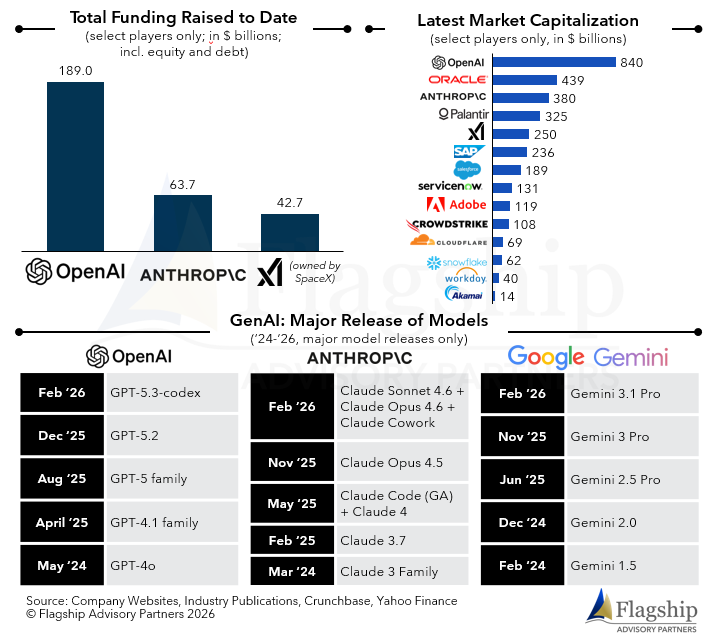
AI disrupters, on the other hand, are skyrocketing in value; OpenAI, Anthropic, and Palantir are now approaching a combined market capitalization of $1.5 trillion, dwarfing most of the market-leading software companies. AI has this capital backing despite not yet establishing many of the revenue streams that will justify these valuations. Clearly, the market is spooked in part from the raw tonnage of possibilities that the rush of capital into AI portends. How can a small-cap or even micro-cap software company compete with these giants who will grow hungry for new revenue models?
Figure 2: GenAI Companies: Funding, Market Valuation, and Key Model Launch Milestones
How Could Disruption Play Out, What Has Investors Spooked?
Investors have grown increasingly worried about AI’s ability to build custom (human guided) or even self-generated (no human instruction) software. That AI can custom develop software that is more agile and uniquely suited to that business’s specific functional requirements. B2B SaaS is a massive category of spend for businesses globally (c. $1.4 trillion in 2025) and corporations spend another $1-2 trillion on employees and consultants to customize, deploy, and manage this software. There is obvious financial motivation for businesses to find more economical outcomes.
We see three distinct potential AI disruption to SaaS vectors (see Figure 3):
Figure 3: AI Disruption Vectors to SaaS
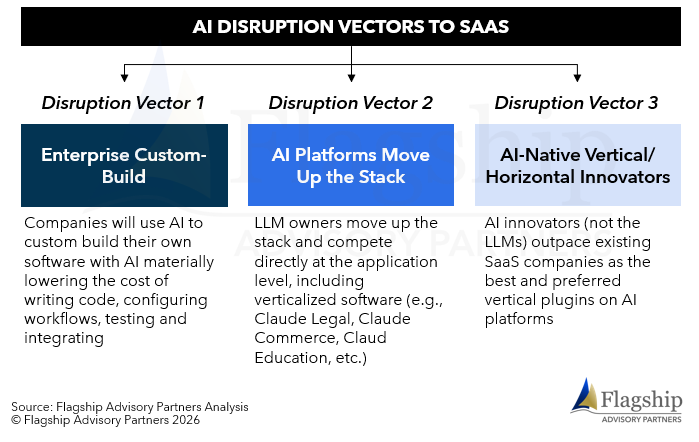
I think we can all agree that disruption vector #1 applies mostly (not entirely) to the enterprise segment. It is hard for us to imagine small and medium-sized businesses en masse investing the effort required to build custom software. SMBs are resources and time constrained with owners that have a low tolerance for nuisance and generally a low appetite for self-disruption. Flagship is a SMB company. We use 27 different software products. We have a lot of smart, young, innovative people in our company, so I do expect us to use some custom AI software in the coming years. But this custom software may not replace any of the 27 software products, possibly one or two on the margin. Of course, the next generation of business owners 10-20 years from now will be more tech savvy and could behave differently.
Disruption vector #2 (AI platforms competing directly as providers of vertical and horizontal SaaS) is mostly theoretical at this point, although there are glimpses that have already fueled part of the market’s panic. Claude, for example, introduced a legal plugin last month designed to assist in tasks such as document review and related workflows. Claude’s legal plugin is a limited purpose tool, nothing akin to broadly functional vertical SaaS such as Clio. It is not obvious to us that AI platforms will want to build and compete across hundreds of specialized software categories. This did not happen on the back of prior innovation/disruption (PCs, internet, mobile apps, cloud computing, etc.). Microsoft did extend its software reach out from Windows and Office but stopped short of attacking verticalized software (it does compete in accounting and ERP). Google similarly does not compete in verticalized software. The precedent suggests that platforms will grow faster by not competing along the tentacles of their ecosystem but rather to continue to expand and monetize the ecosystem core. This leads us to be somewhat skeptical on AI platforms branching that deeply. But on the other hand, these platforms need to justify their $1.5 trillion and growing valuations and business subscriptions are part of that formula.
Disruption vector #3 (AI gives rise to a new class of software innovators) surely will happen, AI disrupters will emerge to eat the lunch of incumbents that do not innovate to AI. Here is where ‘ability to respond’ comes into play for incumbent SaaS companies. It is easy for us to envision disrupters building better legacy forms of niche vertical software that persist (i.e., on-prem windows applications). This is exactly what happened with prior generations of software (first to market disrupted by first to mobile, etc.). We think the long-tail of small, traditional ISVs are in trouble if they are unable to self-disrupt to AI. On the other hand, we struggle to see AI disrupters outflanking many of the market leading SaaS companies who have defensive moats and are already reacting to AI upsides.
What Forms of Software are Most Vulnerable to AI Disruption?
In assessing the reality of this threat, let’s first examine the nature SaaS, the strengths and weaknesses of AI (as it currently exists), and therefore where we can logically expect disruption.
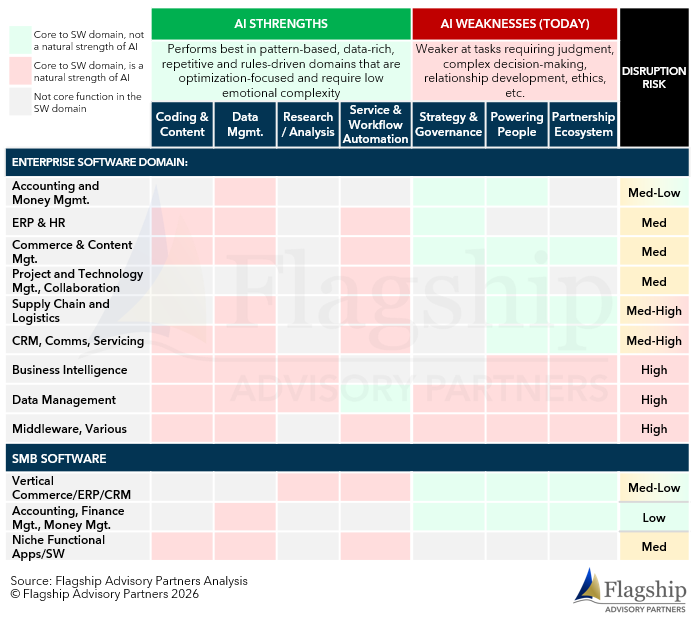
AI is proving to be highly effective at certain functional domains, but less proven in others, which sets the scene for where it is most likely to disrupt software. AI is, or will be good at writing code, automating servicing, manipulating and reconciling data, research, and certain forms of content creation (among others). But AI is not good at strategy formulation, governance, negotiations, relationship building, and people empowerment (among others). AI will certainly keep learning and eventually be good at a broader set of functional tasks, but for now, we can focus the software disruption risk on those areas where it will clearly be effective. And yes, the overlap of what B2B software delivers today and AI’s strengths are clear.
In Figure 4 below, we lay out a basic framework for overlaying AI’s functional strengths and weaknesses onto the functional orientation of different forms of B2B software.
Figure 4: AI vs. B2B Software, Functional Disruption Heatmap
 Beyond the risk of functional replacement, a software company’s risk of AI disruption is the function of its defensive moats and ability to react. Defensive moats include, most notably:
- The existence of a complex ecosystem in and around the software (e.g. software clients using a software product plus five additional integrated SaaS services,
- The degree and complexity of the software customization in driving the business, and
- Unique data possessed by software provider on which the business relies. All of these are barriers to switching and replacement by AI-generated software.
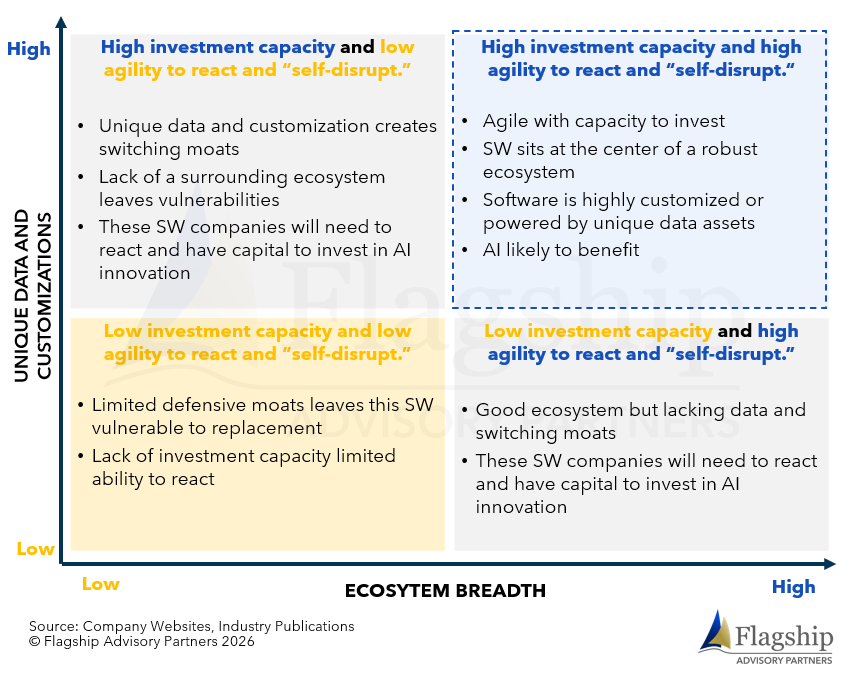
The ability to react to AI as an opportunity for positive disruption is then primarily a function of 1) scale and investment capacity, and 2) cultural agility and willingness to ‘self-disrupt’. Scale by itself is not a strong defense from AI disruption, but scale does translate into capacity to invest, and AI innovation will become increasingly expensive.
On the other hand, we’ve seen many scaled technology companies unwilling to disrupt themselves. In Figure 5, we illustrate this basic framework of defensive moats and ability to ‘self-disrupt’ with AI.
Figure 5: AI Disruption Defensibility
 What Do We Expect to Happen?
OK, let’s move on from consulting frameworks and talk more specifics … where do we see SaaS disruption risk?
Firstly, we see the AI threat as more concentrated in the enterprise segment, where much of the spend (>$2 trillion) sits not only in software licenses but in customization, deployment, integration, and maintenance. Enterprises spend more than $1 trillion annually beyond baseline software licenses, on middleware, parameterization, configuration, and related services. We see much of this enterprise software ecosystem (software platforms, integrators, consultants, etc.) as broadly vulnerable to AI disruption.
We see the enterprise software industry as more vulnerable because they are more susceptible to disruption vector #1 (companies using AI to build their own software). Enterprises will increasingly test the tension between modernizing their software stacks with custom code vs. the pain of transition. Yes, enterprise software benefit from highly customized deployments. This has tended to make technical disruption frustrating slow to materialize in this segment. But enterprises spend a lot on software and related services to maintain and upgrade.
We expect a growing percentage of enterprises to make this leap of faith to embrace the disruption of casting aside some of this legacy. However, ERP, CRM, and other broadly functional enterprise systems benefit from decades of business requirements, regulatory logic, and ecosystem integrations, which are compelling defensive moats. AI platforms are artificially underpriced as they focus on growth, making the business case for AI disruption more compelling for an enterprise, but also riskier. Enterprises are already asking themselves, “do I really want to rip and replace with an AI core given the uncertainty of the cost of that core years from now?”. Will enterprise ERP and CRM platform’s defensive moats be enough to defend their role? This is the trillion-dollar question. We do expect AI disruption across enterprise software, but it will not be wholesale.
Secondly, we believe that vertical software is less likely to be disrupted than forms of horizontal software, at least among market leaders. Market leading vertical SaaS have been winning share from horizontal software applications for years now, building more robust ecosystems, vertically customized experiences, and customized (often proprietary) data intelligence. Noting that the principles of reaction and survival still apply and that even scaled vertical Saas than fails to embrace AI will face risk of disruption.
Note that vertical vs. horizontal is not a binary conclusion. There are forms of horizontal software that have stronger defensive moats, natural functional defense (e.g., accounting), and who will react to maintain their position.
Thirdly, we see market leading SMB software (mostly vertical) as defensible for several reasons:
- SMBs are less likely to build custom software
- Market leading SMB SaaS have already built powerful ecosystems that create tremendous customer stickiness
- The value proposition for SMB software is often strong, creating another defensive moat (i.e., the cost is small relative to the business value of these platforms)
- Ability to react is good among SMB SaaS market leaders
Below we examine each of 2 and 3 above explaining why we see strong defensive moats for leading SMB vertical SaaS.
Robust Ecosystems, Including Embedded Finance, are a Powerful Moat
SMB SaaS (market leading) increasingly deliver a robust ecosystem of functionality, with SMB clients using 10 or more services beyond the core software. SMB users prefer simplicity, which SaaS companies have embraced with robust service bundles, curated extensions, and then a broader marketplace of apps with varying degrees of trust and easy of use via the core.
Figure 6 illustrates the depth of these ecosystems. Shopify merchants have access to approximately 15,000 apps within its marketplace globally. WooCommerce supports over 1,200 extensions in the U.S. alone. Xero and QuickBooks each offer roughly 1,000 and 800 integrations, respectively. But there is also a longer list of SaaS companies such as Clio, Lightspeed, Toast, and Jobber that each maintain, test, and review hundreds of ecosystem integrations.
Figure 6: Integration Ecosystem Strength & Platform Defensibility
(select players only; U.S. integrations/app ecosystems unless stated differently)
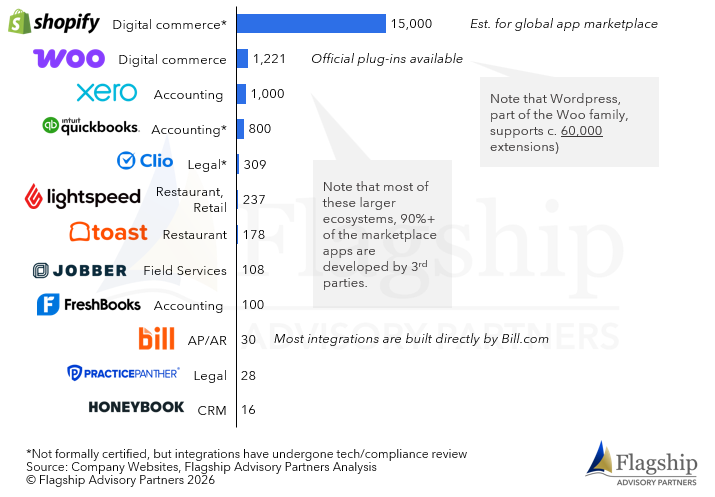
For two decades, API, internet, and mobile technologies have enabled software providers to construct robust integration ecosystems. These ecosystems embed payments, accounting, payroll, marketing, reporting, and third-party applications into a unified operating environment. It is difficult to envision AI effectively replacing the thousands, in some cases tens of thousands, of real-world integrations that underpin these platforms.
Among the most powerful SaaS ecosystem developments is the rise of embedded payments and broader embedded finance. Embedded financial services provide tremendous convenience to SMBs and generate tremendous customer retention. Switching rates for SMBs using core software + embedded payments are exceptionally low (low single digits for top SaaS excluding uncontrollable attrition). Embedded finance is also lucrative, generating tremendous cashflow for leading SMB SaaS to invest in core product and AI innovation.
It is important to note that it’s not quantity, but also quality of service extensions that lead us to believe that leading SMB Saas platforms have strong defensibility. AI platforms will also nurture app ecosystems that foster thousands of plugins. What differentiates leading SaaS is the curation of the most important service extensions. For example, Shopify provides more than 90 native feature sets that tend to extend functionality and usability beyond what open third-party development can achieve.
SMB users do not want a multitude of choices; they want a recommended path that is both easy and robust. This takes curation. We believe that AI platforms or innovators acting on those platforms will struggle to replicate this curation achieved by market leading SaaS across decade of learning and development.
SMB SaaS is Good Value
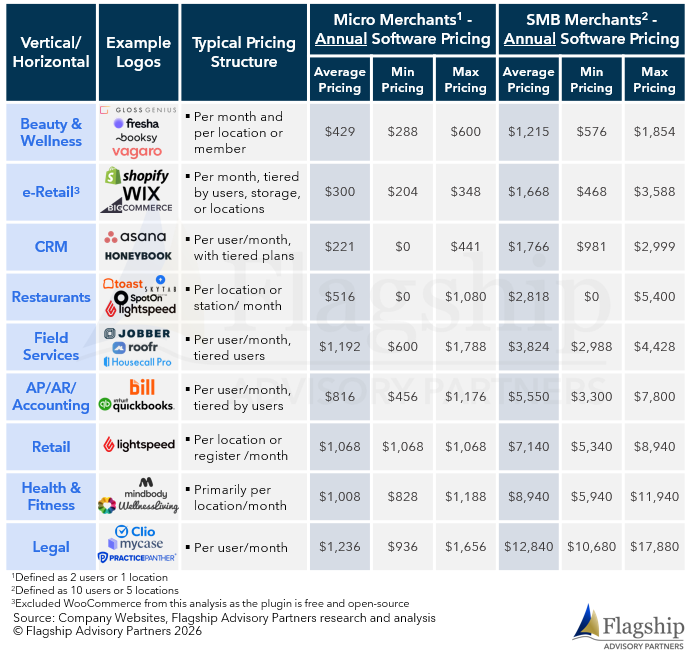
SMB SaaS is often great value, because the software subscription fees are modest relative to the business value delivered. As illustrated in Figure 7, it is common for small businesses to pay only c. $1,000 per year (or $50-100 per month), and for larger SMBs to pay c. $5,000 annually (or $250-400 per month) for SMB SaaS. For a business generating $1 million in revenue, paying $5,000-10,000 for the technology core of the business is tremendous value.
Figure 7: Annual Software Pricing for Micro and SMB Merchants
(select players and verticals/horizontals, U.S. pricing)
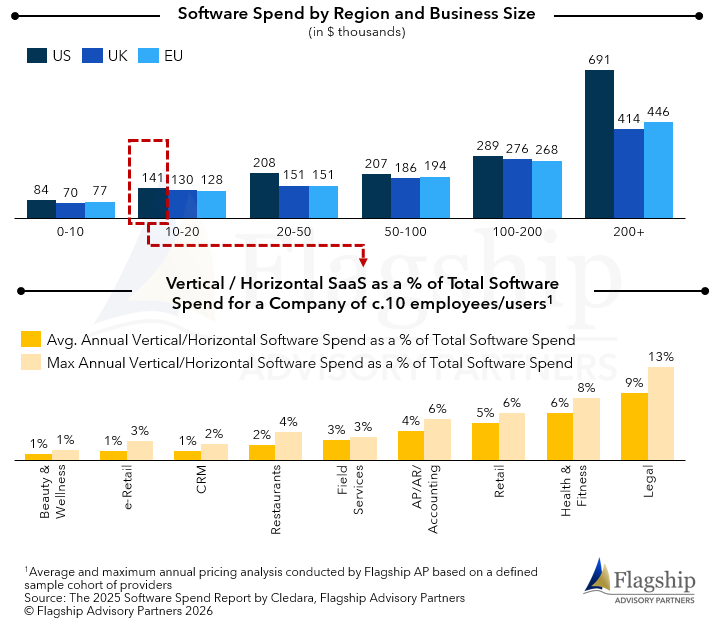
Most small businesses spend less than 5% of total opex on software, which does not make for a compelling AI disruption business case. Figure 8 illustrates typical software spend for SMBs. It is worth noting our own software profile as a case in point. We are a SMB with 50 employees, we subscribe to 27 SaaS products and spend $3,000 per employee on software. As a consulting firm, we use more SaaS on average than other SMBs, but we do not rely on commerce core software (i.e., we are not transacting in real time or at quantity).
Figure 8: Relative Vertical / Horizontal SaaS as a Share of Total Software Spend by Region and Size
Embedded finance is a major reason why SaaS cost is reasonably low in commerce-oriented verticals. SaaS companies that successfully attach payments and other embedded finance services can increasingly offer their software at compelling prices, even free in some cases. Leading SMB SaaS often generate greater-than 50% of gross profit from payments and embedded finance.
Ultimately, we struggle to see AI platforms replicating ecosystem-based SMB SaaS proposition and commercial models quickly or winning share rapidly via switching.
AI as an Upside for Leading SaaS (Particularly SMB)
Beyond the defensive moats we see at leading SMB SaaS, we also see AI as a compelling upside. We see AI driving both revenue and cost benefits for leading SMB SaaS platforms.
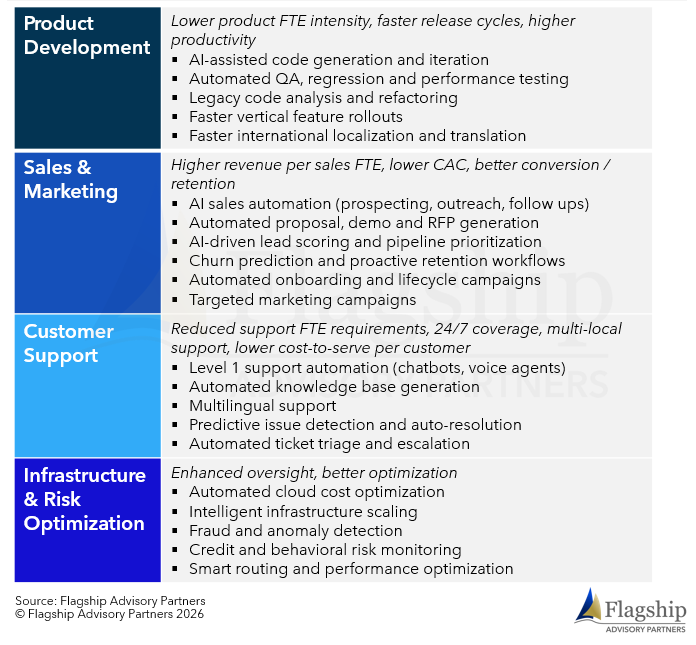
Firstly, AI will lead to major expense efficiencies for leading SMB SaaS, who spend on average 20-35% of all opex and capex on product and technology development on people and a further c.15% on people-based servicing and operations. AI-assisted product development, automated sales workflows, customer support automation, and infrastructure optimization can materially improve operating leverage for market leaders allowing them to invest more into growth innovations or returns to shareholders.
Figure 9: AI Cost Efficiencies for Leading SMB SaaS
(select examples; non-exhaustive)
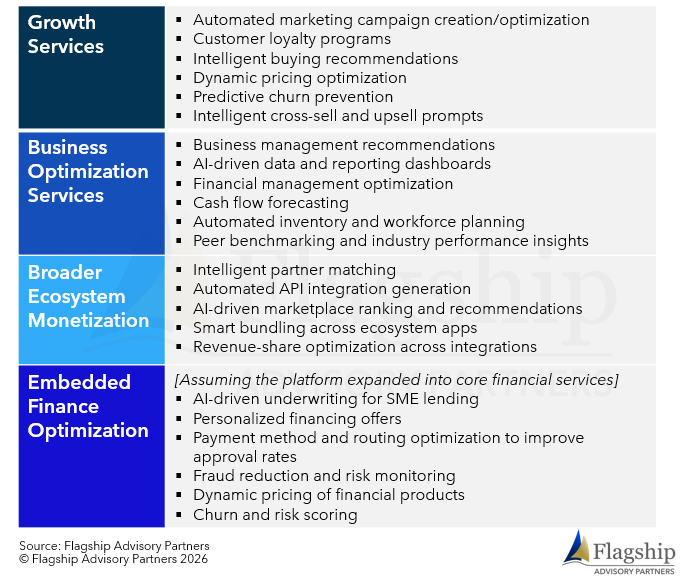
 As shown in figure 10, AI also creates incremental revenue opportunities for leading SMB SaaS across marketing optimization, business management insights, ecosystem monetization, and embedded finance. We are still in the early days of monetization potential of leading SMB vertical platforms, whose revenue is most concentrated in core software and embedded payments. There are many new revenue sources that AI will unveil. Beyond new revenue sources, AI will also unlock a more personalized and better customer experience and operational optimization: AI-driven recommendations, pricing optimization, underwriting, compliance, etc.
Figure 10: AI Revenue Uplift for Leading SMB SaaS
(select examples; non-exhaustive)
Conclusions
AI will disrupt the software industry, but the equity market’s rush out of SaaS stocks feels oversold as we see many leading SaaS companies net-benefitting from AI given their strong defensive moats and ability to react, using AI to create efficiencies and new products. There will be AI disruption more broadly in the software industry. Some software companies will be cannibalized, including enterprise software that do not embrace AI and particularly the long-tail of tens of thousands of ISVs that are poorly positioned to react.
Please do not hesitate to contact Joel Van Arsdale at Joel@Flagshipap.com and Charlotte Al Usta Charlotte@flagshipap.com with comments or questions.