
High-end cardholders (roughly equivalent to superprime and prime plus1) now account for 85% of U.S. credit card spending, up from 81% in 2019. This group has driven all of the growth in purchase volume since the pandemic; prime-and-below borrowers have been at or below zero growth since late 2023.
Every major issuer wants these customers: they spend 6x more than typical consumers, they almost never default (<1%), and at some merchants they earn 40% more interchange. But the standalone economics of the premium cards that target these affluent consumers are surprisingly modest.
Unpacking the Credit Card P&L by Segment
As any credit card professional knows, there are transactors (who almost always pay off their balance in full) and revolvers (who usually don’t). There is a strong correlation between those behaviors and credit quality (62% of below-prime cardholders revolve; only 17% of superprime do) and a moderate correlation between credit quality and income so, while it’s an oversimplification, in the analysis below we compare the P&Ls of an affluent ‘transactor’ using a premium travel rewards card to a middle-market ‘revolver’ using a cashback rewards bankcard.
You might think that credit cards for affluent customers would be incredibly profitable given the marketing dollars invested in them. However, to some degree they offer the same value proposition as a Costco membership: in exchange for paying an up-front annual fee, these products offer great value, as long as you spend enough on them.
Premium cards for affluent consumers generate nearly $1,750 in revenue per account per year, driven by a large annual fee ($395 for the Capital One Venture X Card to $895 for the American Express Platinum Card) and hundreds of dollars in interchange, but very little interest income or other fees. That sounds great, but points and lifestyle credits consume more than 60% of revenue. Add in the amortized cost of huge sign-up bonuses, operations, and cost of funds, and net income lands under $200 per account per year, as shown below in Figure 1. Issuers can easily lose money on high-spending transactors if they don’t carefully manage the effective cost of rewards value propositions like 3% cashback everywhere or 5x points in specific categories - the transactional economics of super-premium cards are razor-thin.
Figure 1: Affluent Card P&L
(illustrative example of a premium rewards card held by a superprime 'transactor')
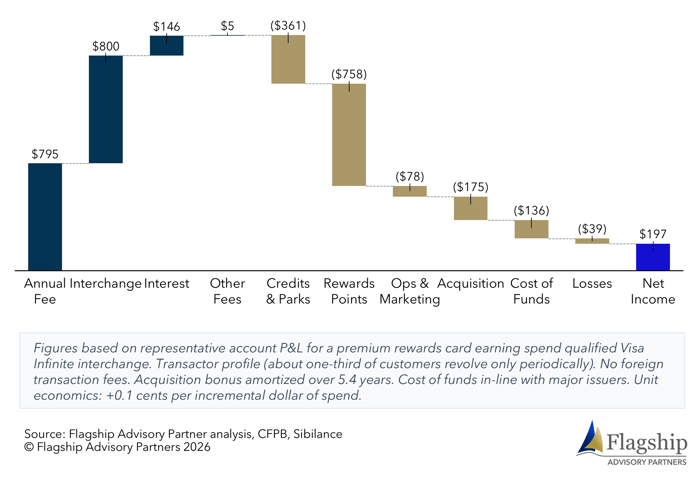
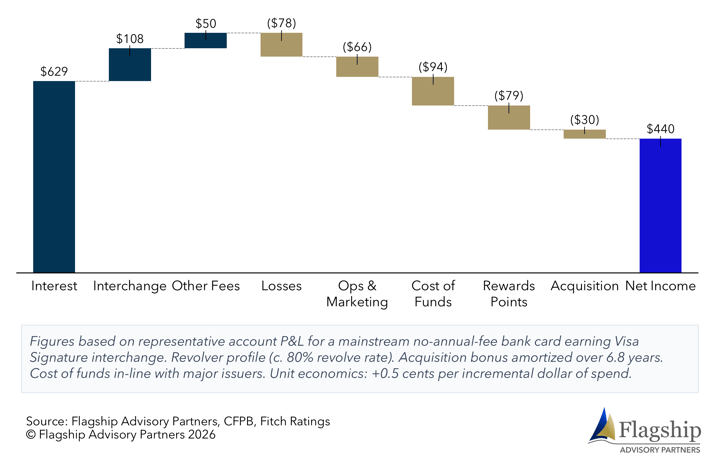
Compare that to a typical prime card with no annual fee: total revenue is much lower at $787 per account per year, driven primarily by interest income (about half of prime cardholders revolve a balance, which is the example we are showing here), but rewards cost just $79. These cards make money from lending and spending with healthy margins (>0.50%) on incremental spend. A typical mass market ‘revolver’ might generate twice the net income per year of an affluent ‘transactor’, as shown in Figure 2.
Figure 2: Rewards Bank Card P&L
(illustrative example of a no-annual-fee rewards card held by a prime 'revolver')
Competitive Dynamics
Without super high annual fees, premium cards lose hundreds of dollars per account per year, which is why we've seen fees on products like the American Express Platinum double from $450 to $895 in the last decade. At some point, fee fatigue will force even the most affluent consumers to pick one premium card instead of holding them all.
No issuer wants to lose these customers. The product updates that top issuers rolled out last year did more than raise annual fees; they also tried to deliver more customer value in creative ways:
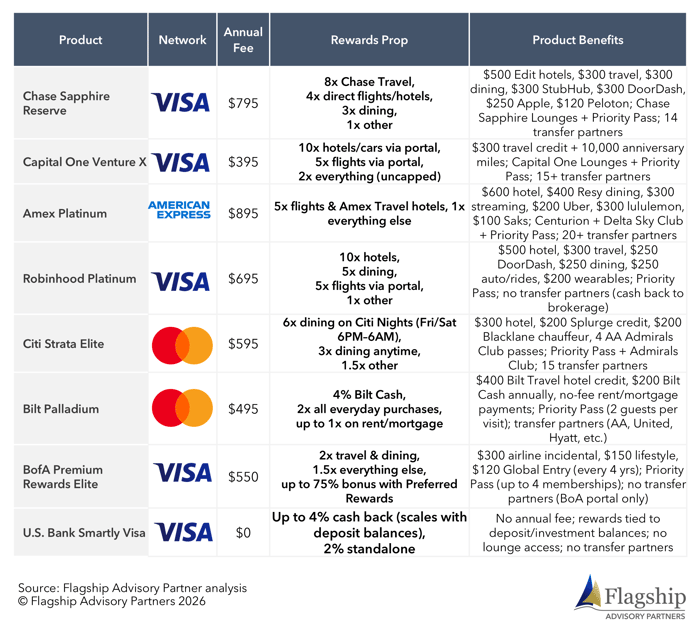
- First, proprietary lounge networks have become a genuine arms race: at JFK or LAS, travelers will now pass an American Express Centurion Lounge, Chase Sapphire Lounge, and a Capital One Lounge. American Express has launched new speakeasy-style Sidecar lounges and Capital One is also rolling out restaurant-style Landing locations. Issuers have long talked about experiential benefits; airport lounges are a straightforward way to make that real.
- Second, value propositions have shifted from a single massive travel rebate to a ‘coupon book’ of lifestyle credits tied to specific brands — Resy, lululemon, Uber, Apple, StubHub, DoorDash, Peloton, Equinox — each with quarterly or semi-annual reset cadences. This structure inflates headline value (Chase advertises $3,000+ in annual value on the Sapphire Reserve) while actually reducing cost: brands often subsidize the credits and any benefits the cardholder forgets, misuses, or can't fit into their routine cost the issuer nothing.
- Third, issuers are adding even more value, but gating it behind spend or relationship thresholds. Sapphire Reserve unlocks IHG Diamond Elite status and a $500 Southwest credit at $75K of annual spend. $25K of spend on the UBS Visa Infinite unlocks a second $500 travel credit. $100K or more of deposits at U.S. Bank will juice their Smartly Visa Card’s cashback rate up to 4% (which has helped U.S. Bank attract $28B in additional deposits over the last year). These constructs are specifically designed to attack the ‘pick one premium card’ pressure point.
Figure 3: Affluent Product Comparison
(illustrative example of affluent cards in market and their propositions)
The Real Reason for Premium Cards
Banks keep investing in this segment (and nonbanks like Robinhood and Bilt are entering it) because premium cards are highly effective tools for customer acquisition against which you can gather deposits, originate mortgages, and cross-sell trading and wealth management services.
The lifetime economics of these adjacent products dwarf the card itself. Take the jumbo mortgage, the natural credit product for an affluent household: a $1.5M-$2M jumbo mortgage held on balance sheet could generate tens of thousands of dollars per year in net income after servicing, credit, and capital costs2. Or, in the fintech world, the Robinhood Gold Card is a great example: its 3% unlimited cashback might seem absurd, and we estimate Robinhood has earned no more than $140 per cardholder (mostly interest) before operating expenses over the last twelve months. But Robinhood’s 4M Gold subscribers3 pay a membership fee of $60 per year, keep 5x more assets under management, and over the last twelve months they have paid Robinhood $656M in margin interest.
The potential value of these other products puts the P&L of a premium card in a different context: an issuer that cross-sells even one product to an affluent cardholder can generate 25-50x the annual contribution of the card itself. The card isn't the product — it's the hook.
Cards are also powerful tools to build brand affinity. Few of the products that a financial institution offers get used frequently enough to really be effective relationship tools. Most Americans get a new car loan every 2-3 years or a mortgage 2-3 times in their entire life. These loans are top-of-mind at origination and then fade to an automatic monthly payment. Most people check their bank and brokerage balances at least weekly, but they usually don’t do anything other than a quick glance.
Cards are the one product people use all the time: the average American transacted 48 times per month in 2024, with 31 of those transactions occurring on their cards. Cards give banks and fintechs the ability to bring their brand to the top of the customer's mind on a daily basis and, in doing so, promote adoption of other products in their suite.
Conclusions
The competition to collect the highest value customers with rewards propositions that eroded the card program’s profitability was historically viewed as a ‘race to the bottom’ by business line managers who focused solely on their own P&L. Today, financial institutions that think in terms of the holistic customer relationship know there is no better tool to win high-value customers than flagship card offerings.
Please do not hesitate to contact Ben Brown at Ben@Flagshipap.com and Ryan McDonald at Ryan.McDonald@Flagshipap.com with comments or questions.
1 U.S. consumers scores are generally grouped into six credit segments: ‘superprime’ (800 or greater), ‘prime plus’ (720 to 799), ‘prime’ (660 to 719), ‘near-prime’ (620 to 659), ‘subprime’ (580 to 619), and ‘deep subprime’ (579 or less). The terms ‘non-prime’ or ‘below-prime’ refer collectively to scores below 660.
2 Illustrative estimate assuming interest rate of 6.5% less term-matched funds-transfer pricing of 4.5% and servicing, credit, and capital costs of 0.6-0.8%.
3 As of Q1 2026 Robinhood has 4.34M Gold subscribers, 800K of which have a Gold Card